


Future decisions are important to water rates

We’d like to thank Nate Van Sickel, president of the Tanglewood Neighborhood Association, for his comments in a column he submitted about FPB water rates. His input helps explain to our customers how important it is for FPB to make smart decisions to control rate increases.

Mr. Van Sickel points out that FPB water rates are higher than comparable neighboring cities. This is true. While our rates are cheaper than Kentucky American Water, they are higher than Bluegrass Area Development District average rates. This is primarily due to reinvestments to improve our water system. And this is why we need to be very careful with projects and costs moving forward.

This is especially true for the decision on replacing the 135-year-old reservoir. This structure has long been the key to our community’s water distribution system. It has lasted far beyond its service life and is in dire need of replacement. To fulfill this need, the board has chosen the least cost design – a solution that not only significantly increases green space, but also would have the least impact on rates.

The Tanglewood Neighborhood Association prefers a plan that would cost ratepayers an additional $3 million for aesthetics and additional infrastructure we may not need for 40 or 50 years. That is not good use of ratepayer money. And for someone who is concerned about high water rates, it just doesn’t make sense.

FPB does strive to keep rates as low as possible. That’s why we are working so hard to move forward with the plan approved by the Board more than a year ago.

Mr. Van Sickel’s argument in the article leads you to believe that our residential customers are paying a higher rate because of the costs to sell water to wholesale customers – but, in reality, the opposite is true.

Infrastructure added to service wholesale customers has been paid for by the wholesale customer – not by FPB retail customers.

Last year, our wholesale customers provided 19 percent of our necessary revenue. If we discontinued sales to our wholesale customers, FPB’s revenue requirements for those fixed costs would not change. Our retail customers would have to absorb those costs and their rates would have to increase by approximately 21 percent.

As you can see, it is a benefit to our retail customers that we have our wholesale customers to help pay our bills.

Again, we appreciate Mr. Van Sickel’s input. We share his concern over higher rates. That is why we value our wholesale customers. And it is precisely why we continue to advocate for the reservoir replacement plan that would keep our customers from paying an additional $3 million for unnecessary infrastructure.

Feedback to the FPB Board of Directors can be submitted to contact@fewpb.com.
FPB approves organizational changes

New structure to streamline coordination between lines of business, improve services for customers.

The FPB Board of Directors approved organizational changes including two new management positions. The new structure will improve coordination and communication across all departments and better leverage all resources of the company to achieve strategic planning goals.

“The board and staff are excited to see how these changes will help improve services for customers,” said Cathy Lindsey, FPB Public Information Coordinator. “Working in a more streamlined structure will increase efficiency and better position our crews to implement new projects in the future.”

The board approved creating the positions of Chief Financial Officer (CFO) and Cable/Telecommunications Superintendent. The board also eliminated the position of Assistant General Manager for Cable Telecommunications.

In addition, the board changed the title of the Assistant General Manager of Operations to Chief Operating Officer (COO). The Cable/Telecommunications Department will now report directly to the COO.

The CFO and COO positions will report directly to the General Manager and support his efforts to provide excellent service to FPB customers and strengthen and improve operations. 

Based on the reorganization, the departments reporting directly to the COO are Electric, Water Distribution, Water Treatment, Electric and Water Engineering, Support Services, Network Operations Center, and Cable Telecommunications. 

The departments reporting directly to the CFO are Customer Service, Information Technology, and Finance.

The Safety and Human Resources departments will report to both the Assistant General Manager of Administration/Staff Attorney and the General Manager.

Due to current vacancies, there are funds available in the current budget to cover any promotional increases that may occur.


###


For news and updates, please go to http://fpb.cc or follow @fewpb and @fpbalerts on Twitter and like us on Facebook.

Outage Wrap-Up

Scattered outages yesterday due to high winds came in waves starting around 3 p.m. There were 14 outages affecting 423 customers. The largest outage, affecting 300 customers, was in the Meadows and lasted from around 8:30 p.m. until 9:30 p.m. Electric crews finished up at 12:30 this morning and are currently working on a few calls of tree limbs on lines. 

We appreciate everyone’s patience as the repairs were made. 

Sun outages may be affecting your TV service

What are sun outages?

  • Twice a year, you may experience some degree of television interference due to "sun outages." Such outages are caused by a phenomenon called a “solar satellite interference." These brief outages occur when the sun passes directly behind satellites transmitting cable signals. When the sun is aligned with a satellite, solar radiation, an energy the sun is emitting, interferes with the satellite’s signal and thus causes a brief signal outage.

When do sun outages happen and how long do they last?

  • Sun outages occur every year, in Fall and Spring, and last about a week each time. This Spring, sun outages are expected March 4 - March 9.

What kind of outage/interference can I expect?

  • During the sun outage, you may experience a pixelated picture, picture freezes, or audio distortions for a brief period of time.

How can I tell if it’s caused by a sun outage or if something is wrong with my cable?

  • The sun outage happens only during the day between 11 a.m. and 5:30 p.m. (no sun, no interference) and is brief, lasting for a few minutes—from 3 minutes, up to 10 minutes.

Networks raise fees on programming

FPB forced to increase rate for Classic Cable

The FPB Board of Directors was forced to approve a $3.50 increase in the Classic Cable rate. This is a direct pass-thru increase – meaning that FPB doesn’t keep that money. It goes directly to the networks on Classic Cable for increased programming costs.

Cable television has so much to offer. At any time of the day, you can find news, sports, movies, concerts, dramas, sitcoms, educational shows, documentaries, kid’s shows, and reality shows and contests.

All of this programming costs money.  And as the availability of content grows, so does the price.

The media conglomerates (seven companies own nearly all of these networks) that provide this content raise their prices to cable providers like FPB every year. That’s what drives this increase.

For example, the media company responsible for about 25 percent of the price change is Disney/ESPN. Sports programming is a major offender. The fans pay the salaries associated with those high-paying athlete contracts. When a sports franchise announces a new TV deal, that means more money coming from the pockets of subscribers. The networks raise the rates to pay for these deals, and cable providers must raise theirs to cover the cost.

All pay-TV providers have had to accept significant price increases from programmers to carry their channels. It has been 24 months since FPB last asked for an increase in Classic Cable rates. FPB has absorbed as much of the increase as possible before passing it on to the customers.

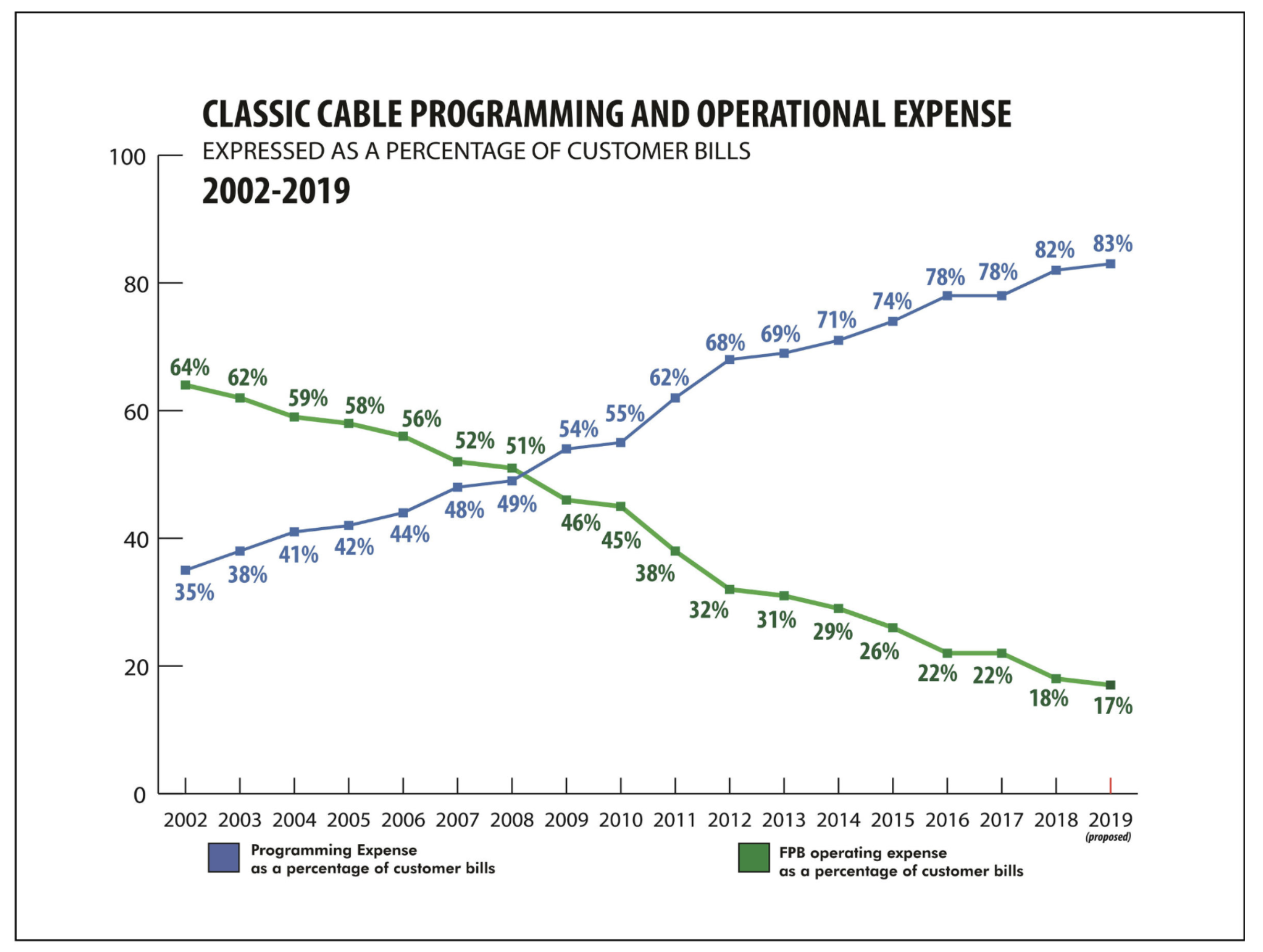
In fact, in the past 16 years, while programming fees FPB pays to the networks has increased almost $61, FPB has managed to decrease operational expenses by more than a dollar per customer each month.

FPB only keeps 17 percent of your Classic Cable bill for operating expenses. This includes maintenance on the system, equipment and paying the cable installers to get you hooked up and serviced when needed.

The rest of your bill, 83 percent, leaves Frankfort and goes directly to the network programmers.

Rate increases for programming content are not unique to Frankfort or FPB. In the past two months, companies such as DirectTV, AT&T, Comcast, Charter and Dish have all raised prices for 2019.

Virtual operators such as DirectTV NOW, YouTube TV and Hulu Live have also either raised their prices or have announced coming increases.

Even Netflix isn’t immune to the increased cost of content. Their most popular plan will increase by nearly 20 percent next month – their third increase in the last three and a half years.

While the FPB Board of Directors would prefer to hold down costs for cable customers, it is committed to providing the programming customers demand. Unfortunately, that means setting rates to keep pace with the increase in the wholesale license fees that FPB must pay.

 
Classic Cable Programming and Operational Expense
 

###


For news and updates, please go to http://fpb.cc or follow @fewpb and @fpbalerts on Twitter and like us on Facebook.